
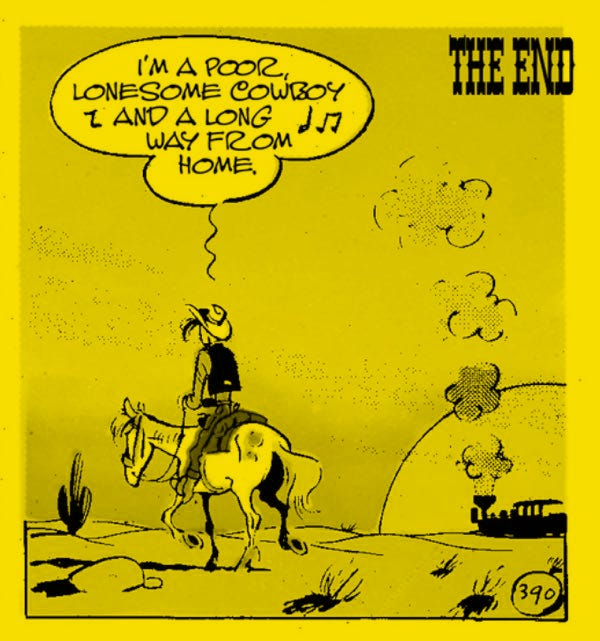
I’m just a lonesome L.A. cowboy, hangin’ out, hangin’ on / To your window ledge, callin’ your name from midnight until dawn / Smokin’ dope, snortin’ coke, and tryin’ to write a song / Forgettin’ everything I know ‘til the next line comes along. —Old & In The Way
I am never alone.
I mean this quite literally. And ontologically. Privacy, vaporized by family. Existential isolation, obliterated by conscious contact with God.
But eleven years ago, I was one lonesome L.A. cowboy.
No family. No God. Just Drew.
Looking back, it’s not that easy to pinpoint when conviviality (or the promise of it) gave way to desolation. I remember, growing up, hearing that “drinking alone” was considered taboo. That kind of moralizing was never going to stop me. And was I really alone if I was passing the time together with Alexander Keith or bloody mary? At a certain point, though, even drinking with other humans was drinking alone. And aren’t cowboys of every stripe (notably) “always alone, even with someone they love?’
That’s something I often come back to when I think about the precipitant (as it were) to my sobriety.
I had run out of love.
I couldn’t really give it. And I definitely couldn’t receive it. And that’s a lonely place to be.
Today, that’s the furthest thing from the case. I live in a house full of love. And it’s gotten markedly fuller since I last wrote (regularly) here. Four humans. 1200 square feet. One bathroom. And a 60-pound dog.
But in that respect, I sometimes feel like an outlier.
This is the era of the lone actor, the lone operator. The chronically single. We’re told loneliness is an epidemic. We’re told Gen Z is a lonely generation. (And also a dumb one, apparently.)
Per usual, I was way ahead of my time. Lonely. And dumb.
At a certain point, alcohol and that aforementioned “next line” had become the source of my regularly scheduled loneliness programming. At the beginning of the night, the plan was never to end up in the bathroom staring into the mirror with a rolled up bill in my hand, my delusionally inflated / deflated reflection my only (bad) company. But that was the oft demoralizing outcome. And it seemed preordained, commanded, and beyond my control.
Sobriety was the cure for all that.
And while I do miss having the bathroom all to myself on occasion, I don’t miss that inflammatory ooze that was the rest of it.
Alcohol consumption rates in the United States have fallen to a 90-year low. At the same time, the U.S. Surgeon General “warns about the public health crisis that loneliness, isolation, and disconnection pose to the American public.”
Are these two trends related? Are people drinking less because they are lonely? Or are they lonely because they are drinking less?
In response to the World Health Organization’s claim that there is “no safe level” of drinking, Heineken CEO, Dolf van den Brink, said that “in this time of loneliness and a mental health epidemic,” beer’s role as social catalyst was “important to make part of the public debate.” He argues “the relationship between alcohol and health is complex.” Is it really, Dolf van den Brink? Maybe for a normie. But never for me.
And while “belief [that] moderate drinking is bad for health” has risen to new heights, Asahi CEO, Atsushi Katsuki, asserts that “alcohol sales [have been] hit more by screen time than health fears.”
Which brings us back to those who are screen timing more and drinking (and f*cking) less than ever. It’s hard to comprehend that what scrolls past in brilliant blue light on an iPhone is more powerful than what you’ll find in a bottle of Cazadores. But it is. The “continuous high-volume instant-gratification loop” provided by short-form video content and social media delivers “a nearly constant stream of, often small, dopamine hits.” And as those hits compound, the brain craves ever more scroll as it—quite literally—rots.
Given those same screens are deemed the cause of Gen Z being “the first generation in modern history to score lower on standardized academic tests than the one before it,” it makes me really nostalgic for a time when it was just the horfing down of nitrous balloons that made us dumber.
I can’t help but think that the through line here is a setting of the mind that has been shaped by addiction—not to the vices of the 20th century but the 21st one. A more powerful substance can always make another obsolete, toothless. When you’ve got the warm embrace of oxycodone ketamine, who really needs a Bud Light, right?
And addiction is isolating. Booze, porn, gambling, TikTok can all lead to estrangement from friends, family, community, and love. Who needs you if I have “my precious?”
In Lacanian terms, loneliness is not simply the absence of others. It reflects a “lack” in being (manque-à-être) that desire perpetually tries to fill.
Isn’t this what the digital vice cartels are so good at packaging and exporting? Lack? They are remorseless peddlers of it. And around it, an “economy of loneliness” has sprung up. In this day and age, connections aren’t missed. They’re nearly extinct. That 31 percent of young men “had chatted with an AI system meant to emulate a romantic partner” portends we all will be soon enough.
The cure for loneliness isn’t togetherness, though.
It’s learning to accept the totally natural human sensation of solitude. In my experience, the power to re-connect to love was entirely contingent on my ability to sit with myself in silence.
The powers that be don’t want you to do that.
They want you in lack.
That way you’ll still go out to buy their beer.
Or, more and more likely these days, stay home alone and chat up their AI paramours.
What a quandary... when larping a life is more interesting than actually living that life, you almost feel sorry for them.