
“That’s the sort of game squash is: remorseless, self-policing and deeply, if quirkily, moral. A squash match is a test of character as well as skill, of will as much as prowess. It calls for a delicate balance between aggressiveness and sportsmanship, hustle and trust. There are many ways to cheat at squash, most of them subtle and often undetectable. The question, ultimately, is not just how badly one wants to win, but what sort of victory is consonant with one’s dignity.” —Laurence Shames
It’s fair to say then that sobriety—like squash—is a delicate balance of “hustle and trust,” right?
“Into action.”
“Let go and let God.”
That’s how we do. Living in paradox. Hopefully happily.
This is something with which many out there seem to be struggling mightily right now, an unmanageable aversion to life unfolding in any shade of gray, to ceding control where there is none to begin with.
Whatever the problem, though, thinking about doing something about it is not doing anything about it. From a Taoist perspective, not doing anything at all is probably way closer to actually doing something than thinking about actually doing something.
“One does nothing, and nothing is left undone.” —Lao Tzu
If alcoholism is indeed “a thinking problem” then perhaps the safest place for an alcoholic to be at any given time is on a squash court.
As one player (and fellow sober stud) once noted: “The thing I love most about the game is that there’s no time to think. It’s the anti-golf.”
On a squash court, there’s barely enough time to react, let alone overreact. Squash provides the perfect blend of doing and not thinking. And if thinking is the opposite of doing then, by the principle of binary opposition, not thinking is doing.
So, I’ve been doing 45 minutes or so most days on a squash court, rhythmically hitting forehands that careen off the front wall and left side wall that turn into backhands that hit the front wall and the right side wall that become forehands again. This cat-like meditation of aggression goes on for as long as I can keep it going. Miss the mark. Start again.
As Carl Jung writes, “Man’s task is to become conscious of the contents that press upward from the unconscious.” And for whatever reason, for me, this is more likely to happen when meditatively hitting a ball than, say, sitting in a pew or (these days) on a zafu.
In my experience, pouring myself into anything—sobriety, crystals, breathwork meditation, squash—has the same effect. The receptacle is irrelevant. It’s the pouring that matters.
Ram Dass talked about playing golf without being a golfer. From my tortured experience on a golf course, you’d have to be as enlightened as he was to do that.
On a squash court, though?
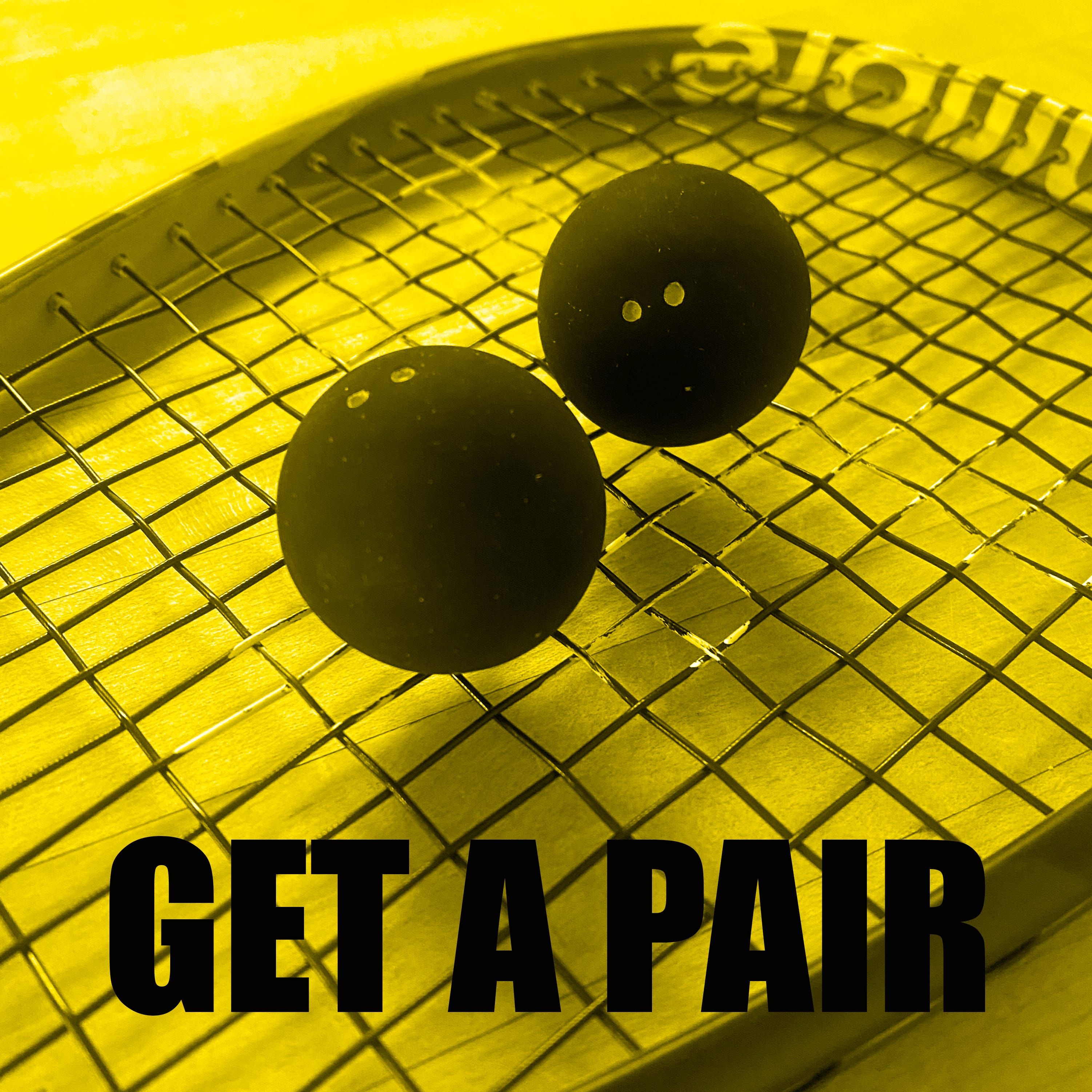
It’s hard to be anything when you have a 1.5-inch rubber ball en route to your face at 100 miles per hour. Am I a squash player in that moment? A husband? A father? A writer? A sober alcoholic? Or am I Jaqen H’ghar? “A man has no name.”
And I think that’s the crux of my spiritual life. It’s when I’m the furthest thing from any kind of label that I find myself actually inhabiting it.
The truth is, I can’t just do the sign of the cross and be “a spiritual person.” No one can. A “spiritual person” doesn’t exist. Because, as Jung posits: “Spirit is autonomous.” All you can do is book the court and hope it shows up to play.
Jung suggests that many confuse contact with spirit as being spiritual, “The persona can even assume a religious form, and in this way the individual may appear to be spiritual without having undergone any real transformation.” Here, I think of those victims and perpetrators of “plastic shamanism” who make ayahuasca their whole thing, attempting (and failing) to make the uncommodifiable a commodity.
Point being, there may be someone out there in a Chipp club tie with a copy of The Economist tucked under one arm and a 125-gram squash racket under the other running spiritual circles around you and me. And alone and locked in with God (and the present moment) in a 32-by-21-foot box, I’m literally running circles around myself. And in the process, losing myself. It’s squash palace. And dojo.
And I’m talking about practice. Not a game! Practice.
Introduce another middle-aged man sprinting (lumbering) and reaching (flailing) onto the court, and the game becomes an apt metaphor for la vie en sobriété.
I can’t run you over. I can’t stand in your way. I can’t go it alone. And I can’t cheat without cheating myself. If I take my eye off the ball, I’m in trouble. There’s nowhere to hide. There’s no escape. And it’s f*cking fun.
As the playwright, Noel Coward, said: “Squash—that’s not exercise, it’s flagellation.”
Good.
Because, I’ve heard that “discomfort is the price of admission to a meaningful life.” There’s precedent, of course. The keisaku. The cilice and “the discipline.” I wouldn’t go so far as to put a squash racket on that level.
A two iron, though?
Most definitely.